【Shanghai Daily & JING’AN News】Moments in July
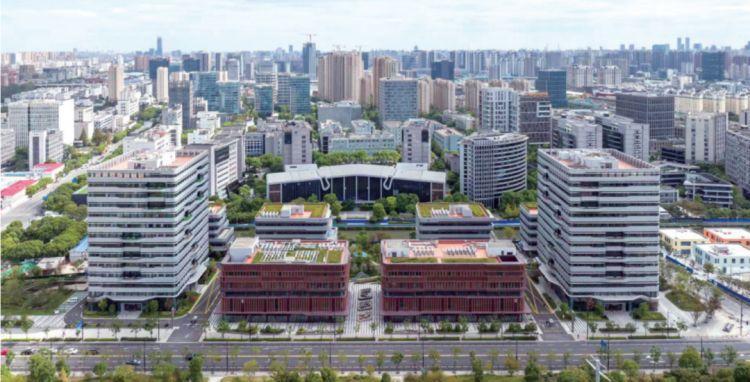 Building a trusted data economy pilot zone
Jing'an is embracing digital intelligence in its development blueprint, with Shibei High Technology Park serving as a powerful engine. It is one of the first demonstration parks for urban digital transformation in Shanghai and the only one designated as a pilot area for implementing cutting-edge blockchain applications.
It is collaborating with Shanghai Data Exchange and Lingang International Data Port to create a data factor market innovation system that can serve as a benchmark for interna- tional practices.
It is assisting Jing'an District to build a trusted data economy pilot zone.
Shibei, in collaboration with Ant Group, East China Normal University and other reputable institutions, announced the initiative to establish the Shanghai Trusted Data Economy Research Institute during the Global Industrial Blockchain Summit held this month during the World Artificial Intelligence Conference, or WAIC.
The institute plans to make Shibei a center for the development of cutting-edge applications of the trusted data economy and play a significant role in industrial collaborative innovation, global exchange and other fields. It also hopes to develop into a highly professional and influential think tank.
A ceremony was held to welcome newcomers to the Shanghai Antchain Industrial Development Center in the Blockchain Valley of Shibei.
The center has brought together 16 companies in the roughly six months since it began operations, as well as nurtured and provided services to 19 businesses, eight of which are involved in high technology. They contribute to the creation of a Web 3.0 ecosystem focused on Jing'an and span application scenarios like food traceability, gaming and insurance verification.
One of the first to arrive at the center was Shanghai Magic Orange Network Technology Co.
According to the founder, Chen Mintao, thanks to the diversified resources in the park and technology support from Antchain, the company has grown from a “single product developer” to a “comprehensive ser- vice provider” that has served more than 50 industrial scenarios, especially the application of blockchain in new-energy vehicles to secure data safety.
“The development of blockchain needs systematic support from the downstream and upstream industry chains,” he said. “Here in Shibei, we can find them all, which is helping us to grow bigger.”
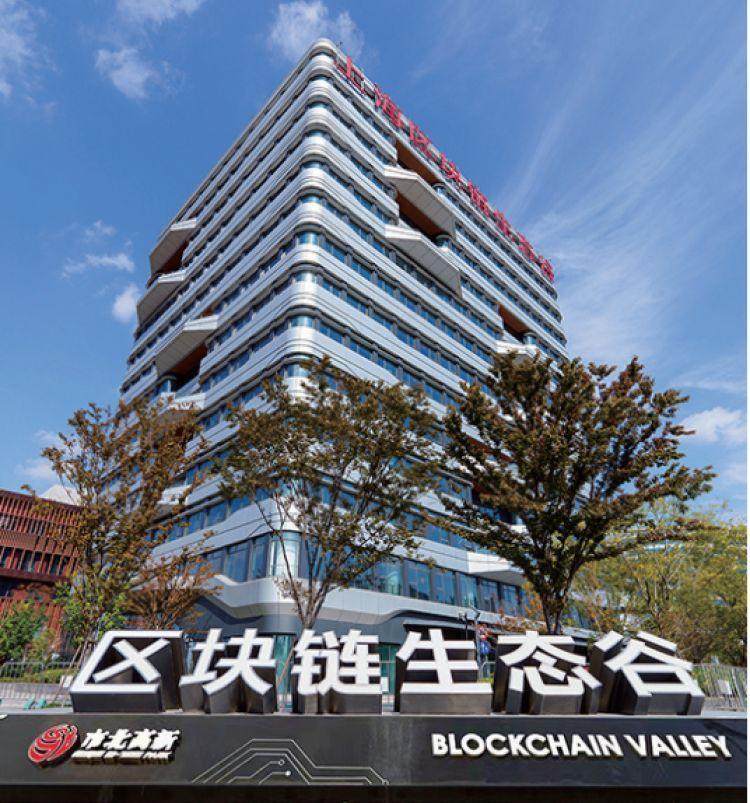
The Blockchain Valley of Shibei High Technology Park
Blockchain Valley has gathered 70 well-known companies from home and abroad. It has led the way in examining a new pattern of growth that combines industrial clusters, applications and technical innovation.
Shibei claims that it is focusing on developing blockchain, cloud computing, big data and artificial intelligence to drive a new wave of digitization.
According to the Jing'an Science and Technology Commission, the district will expedite the construction of the big data industry base, the AI hybrid cloud computing power center, the Huawei Blockchain Ecosystem Innovation Center and other major projects to promote the deeper integration of digital technology and the online economy.
Suhewan, Jing'an's waterfront area along Suzhou Creek, is intended to become a fintech highland. The Nanjing Road W. commercial zone will host more headquarters of companies in the technology service industry, and the Daning area will concentrate on developing emerging industries like chip design, new materials research and development and smart healthcare.
A revolutionary memorial and an art landmark
Former CPC secretariat opens to the public
The former Central Committee Secretariat of the Communist Party of China has been renovated into a revolutionary memorial and is now open to the public.
The secretariat, regarded as the forerunner of today's General Office of the CPC Central Committee, was formed in Shanghai in July 1926 and relocated in November 1927 to a two-storey shikumen (stone-gate) building at No. 10, Lane 673, Jiangning Road.
Until the mid-1930s, CPC leaders such as Zhou Enlai and Deng Xiaoping came to read and analyze critical documents and attend secret meetings.
Everyone there led a double life in order to conceal their revolutionary efforts.
Zhang Ji'en, a secretariat clerk, rented the residence as the son of a wealthy businessman under the alias Huang Jici. He lived on the first floor with his wife, and the office on the second level was set up as a single room, complete with a bed, closet and table.
On June 23, 1931, police stormed the house but discovered nothing significant because the documents had been moved somewhere else for safekeeping. Nonetheless, Zhang and his wife were arrested. As a result, the site was later abandoned.
The site was designated as “under protection” in December 2017. In June 2020, work on restoring it to its original appearance began.
The structure has been restored to its former appearance from over a century ago. The historical layout of the apartments where the early Party members lived has also been recreated.
The memorial has 505 square meters of exhibition space and includes 78 images and 21 artifacts.
Using naked-eye 3D display technology, visitors are immersed in the days when revolutionaries risked their lives in covert activities.
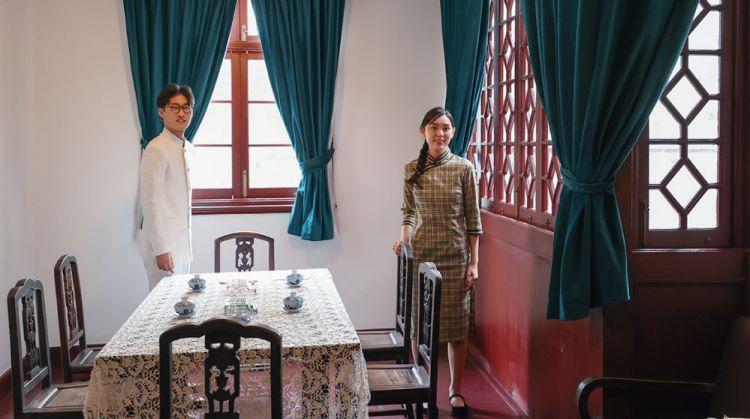
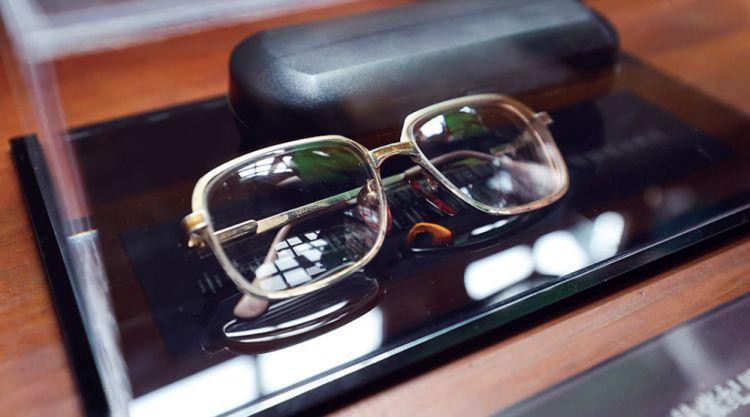
Immersive scenarios and artifacts are featured at the revolutionary memorial of the former Central Committee Secretariat of the Communist Party of China. — Jiang Xiaowei
Art ripples around Suhewan
With the “Art Ripples” campaign, Jing'an is transforming its Suhewan neighborhood into a new landmark on Shanghai's art map.
Suzhou Creek passes through Jing'an for about 6.3 kilometers, and a 4.2-square-kilo-meter shoreline region is known as Suhewan, literally Suzhou Creek Bay.
The area has 500,000 square meters of historical structures, 17 conservation neighborhoods and 170 cultural spots, including world-class art institutions like Sotheby's, UCCA Edge and Fotografiska. They have created a comprehensive art ecosystem.
Jing'an launched the “Art Ripples” campaign this month to better integrate the abundant waterfront cultural resources.
An art coalition comprised of waterfront art institutions, commercial complexes and other industrial giants was formed as part of the campaign. In addition, an app called “Art Ripples” would be developed to create a world-class online art exchange platform.
Other historical sites will be renovated to become modern exhibition halls. Tianhou Palace, Shanghai's biggest temple to Mazu (the goddess of the sea) dating back to the late 19th century, and Shen Yuli, one of the city's best-preserved shikumen (stone-gate) neighborhoods with a nearly 100-year history, would provide cultural venues that integrate the old and new.
Local creative parks and commercial complexes such as Sihang Tiandi and Jing'an International Center can provide nearly 80,000 square meters of space for art and industrial players.
Tours that connect cultural and historical waterfront locations and are connected with the Suzhou Creek cruise will also be launched, along with a VR guide map.
There would be a music festival, a theater extravaganza, a sculpture exhibition, a tea culture festival, a rowing competition and other events. Suhewan, in particular, is expected to have its own art biennial.
To entice new art institutions, Jing'an will award up to 1 million yuan (US$139,252) to those who have made significant contributions to the district's art and culture development.
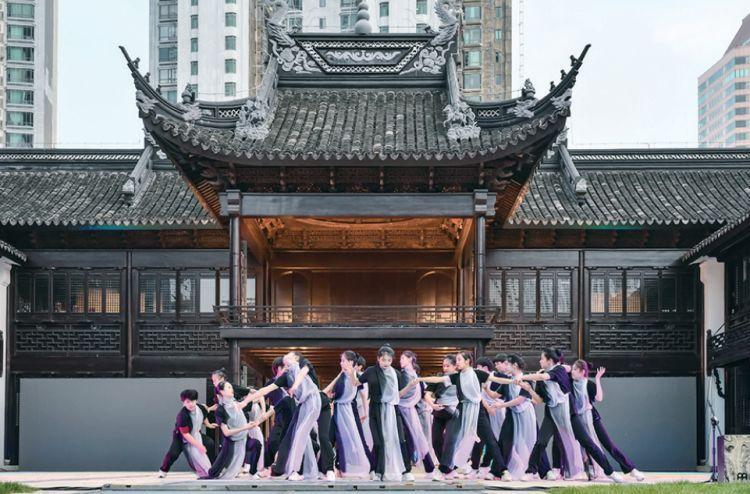
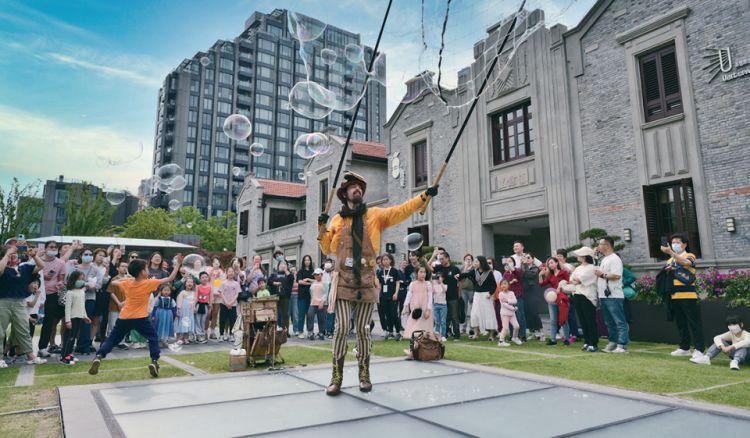
AvarietyofshowsarestagedintheSuhewanareaduring the “ArtRipples”campaign.
Upgrading the community, biz environment and public services
Fangua Long takes on a new look
The subdistrict develops around the Shanghai Railway Station, to the north of which is filled with old neighborhoods in a state of disrepair, particularly Fangua Long.
It covers an area equal to nearly 8.5 standard football pitches, and is home to more than 1,122 families.
In the 1920s, Fangua Long was one of the most prosperous areas in the old Zhabei as the establishment of the railway station in 1909 brought a flood of businesses. However, it later came under shellfire and air raids, and was reduced to rubble.
In the 1940s, it became the city's most densely-populated slum, packed with refugees uprooted by the war. Most lived in shanty huts and hovels put up with bamboo, straw and mud, without running water, a toilet, drainage or other facilities.
In 1947, the area produced a super large pumpkin, known by locals as fangua, and thus it got the name Fangua Long, literally pumpkin lane neighborhood.
After 1949, the local government launched several rounds of renovations to improve local people's living standards. In the 1960s, especially, the rundown shelters were renovated to build multistorey houses equipped with modern facilities including running water, electricity and gas. Banks, bookstores, eateries, hair salons and other support facilities were also erected in the neighborhood.
Over the years, however, the neighborhood gradually fell into a state of disrepair with cracked walls and leaky ceilings. Worse, shared toilets and kitchens often triggered disputes among neighbors. Local residents were eager to leave the neighborhood.
In the latest round of renovation, 14 decrepit buildings will be demolished, to be replaced by six new apartment buildings, with every unit equipped with an independent kitchen, toilet and balcony. A two-storey underground garage, a large courtyard garden in the middle and other lifestyle facilities will be erected.
Relocation has begun, and is set to be completed by the end of September. Residents will move back three to four years after the new Fangua Long takes shape. The local government will cover part of the rental fees for residents during that period.
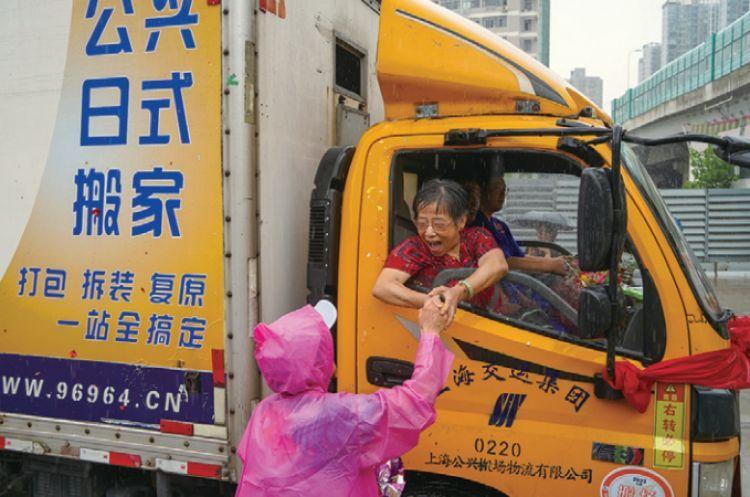
A Fangua Long resident says goodbye to her old neighbor. — Jiang Xiaowei
Creating a magnet for businesses
To make the subdistrict a magnet for businesses, a service team has been set up to improve the local business environment.
The team consists of officials from the district's commerce commission, science and technology commission, human resources and social security bureau, investment promotion office, finance office and other departments in the subdistrict.
The team will visit office buildings on a regular basis to offer a wide range of services such as administrative approval, policy consulting and talent recruitment.
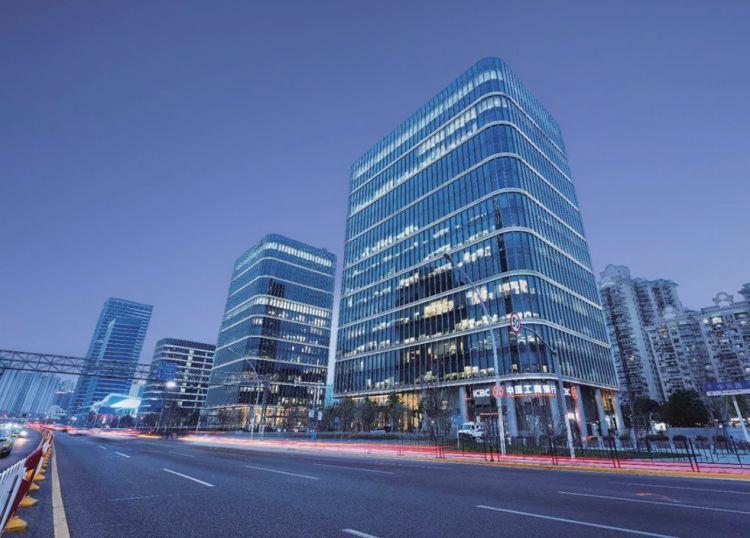
The subdistrict is also working to improve the capacity of 34 major business and commercial complexes including the Jing'an International Center, Skyline Tower and the Financial Street Joy Center. A set of favorable policies will be made to attract renowned firms to the area.
Services for residents and companies
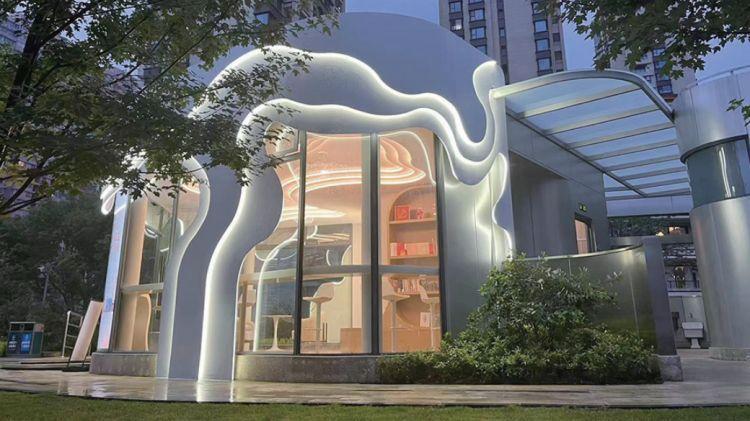
A new public service station opened this month near the Jing'an International Center along Suzhou Creek, aiming to serve three residential complexes and 20 high-end office buildings that accommodate nearly 1,300 companies.
A wide range of services including information about volunteering, healthcare, reading, business and more are on offer.
Not far from there, a service center is being built to serve local companies.
The site, covering an area of more than 1,000 square meters, is set to be put into use by the end of this year.
It will provide one-stop service, from guiding companies to register local offices, explaining the latest policies, and recruiting and training talent, to incubating business ideas.
It will also build a bridge between companies and the authorities.
Other public service sites in the subdistrict include a volunteer service center on Hengfeng Road, a comprehensive civil affairs service center on Hutai Road, two community canteens on Chang'an Road and Zhonghuaxin Road and 12 service spots embedded in neighborhoods.
资料:区新闻办、上海日报
来源:上海静安
